
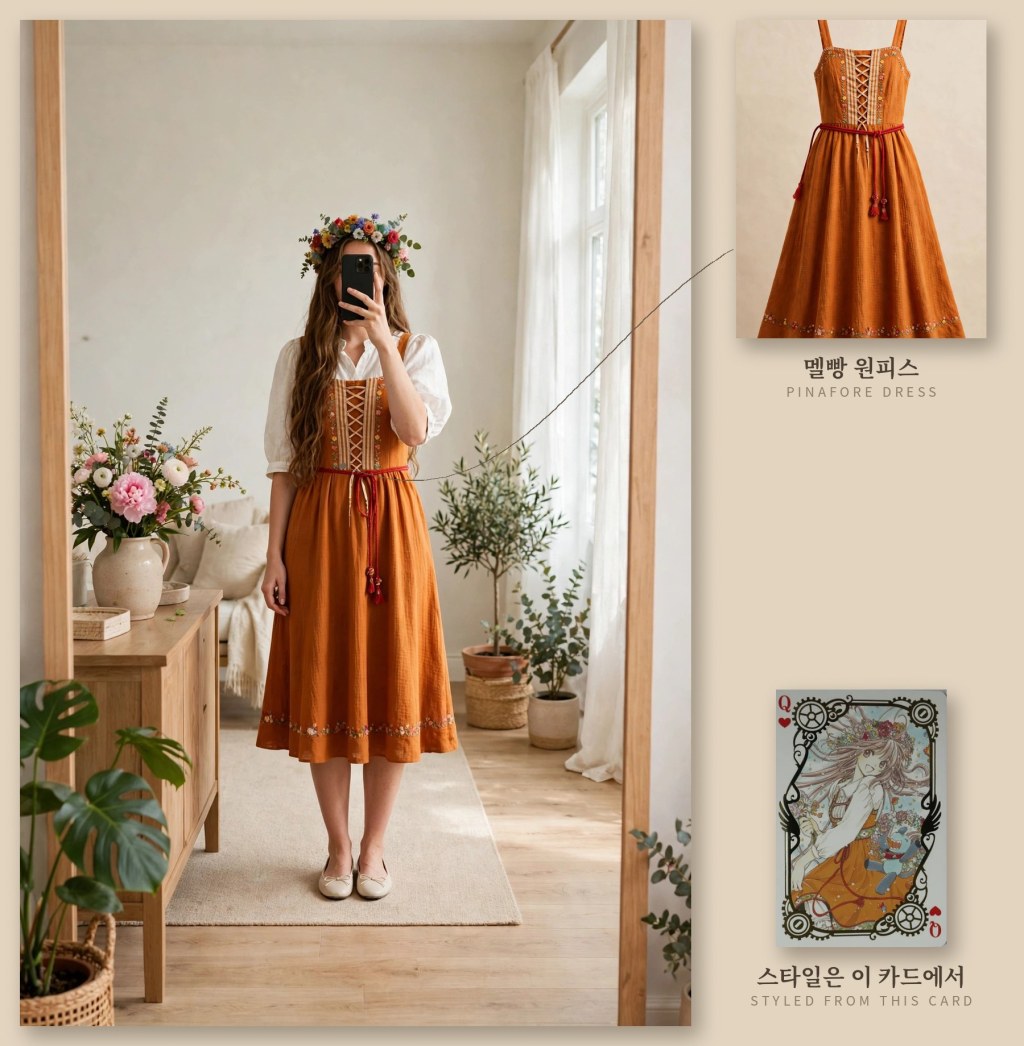
A dress is supposed to be a finished outfit. Kobato Hanato’s, on the Queen of Hearts of the CLAMP exhibition deck, is not — it is a layer, worn over a blouse, and that one decision is the whole look. The blouse underneath is loose, the dress over it is loose, and the silhouette still lands, because the dress carries its own drawn lines: a laced front panel and a red cord at the waist.
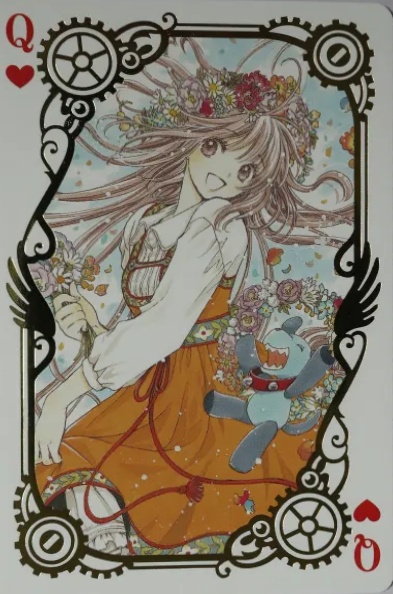
Kobato is the heroine of CLAMP’s Kobato.: bright, pure-hearted and cheerfully clumsy, sent to fill a bottle with the healed hearts of the people she helps so her own wish can come true. The blue creature at her side is Ioryogi, her companion — all scolding on the outside, all protection underneath. Her card is a spring festival in one frame: flowers in her hair, a bouquet in her hands, petals everywhere.
What Is This Look?
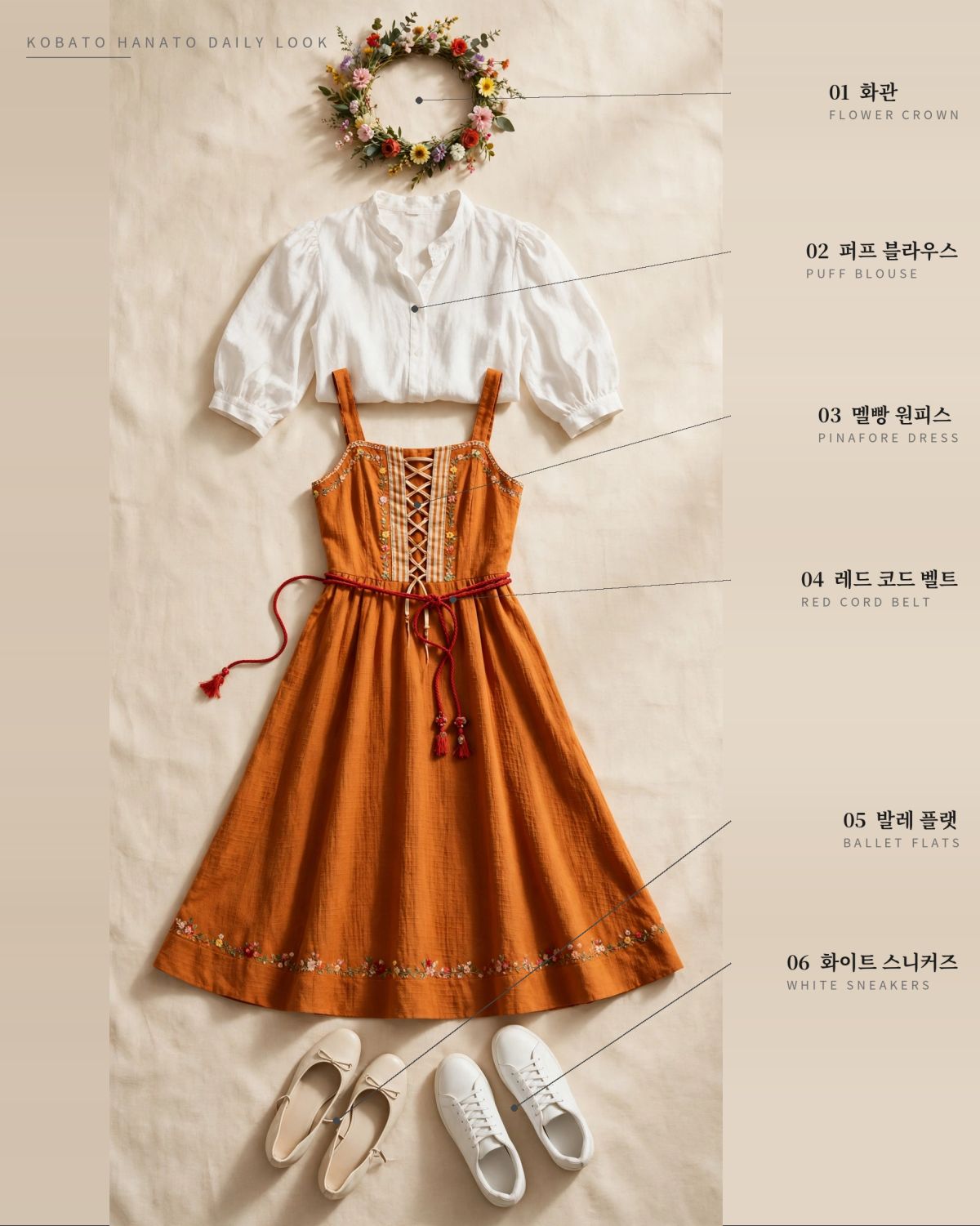
On her head, a flower crown: small blooms in pink, white and yellow, worn like a wreath. Under it her hair falls in long loose waves — the card has it streaming sideways, full of petals.
Underneath everything, a white blouse with soft puff sleeves. Over it, the single main garment: an amber-orange pinafore dress on shoulder straps, its front bodice panel striped and laced, its long gathered skirt finished with a band of small floral embroidery along the hem.
Around the waist, over the dress, a long thin red cord tied once, its tasselled ends hanging down the skirt. The card hides her feet entirely, so the shoes are a proposal — cream ballet flats first, white sneakers to bring the flowers down to earth.
The Point
The point is that this dress behaves like separates. Because it is a pinafore — straps over a blouse, not a closed dress — the outfit’s equation has two variables. The dress supplies the colour, the laced panel and the long embroidered skirt; the blouse supplies the sleeves and the neckline. Change the blouse and the same dress becomes a different outfit, which no ordinary one-piece allows.
It is also how the silhouette survives all that looseness. Nothing here is fitted: the blouse billows, the skirt flows. The waist exists because the dress draws it twice — the laced panel shaping the front, the red cord underlining it — lines laid over soft clothes rather than cut into them. Romantic, in this outfit, is not a body shape. It is a stack.
The flower crown is the signature, and it is optional in a way the dress is not. Crown on, the outfit is a festival portrait. Crown off, it is a spring pinafore set that passes anywhere — the structure stays behind when the signature leaves.
Styling Tips
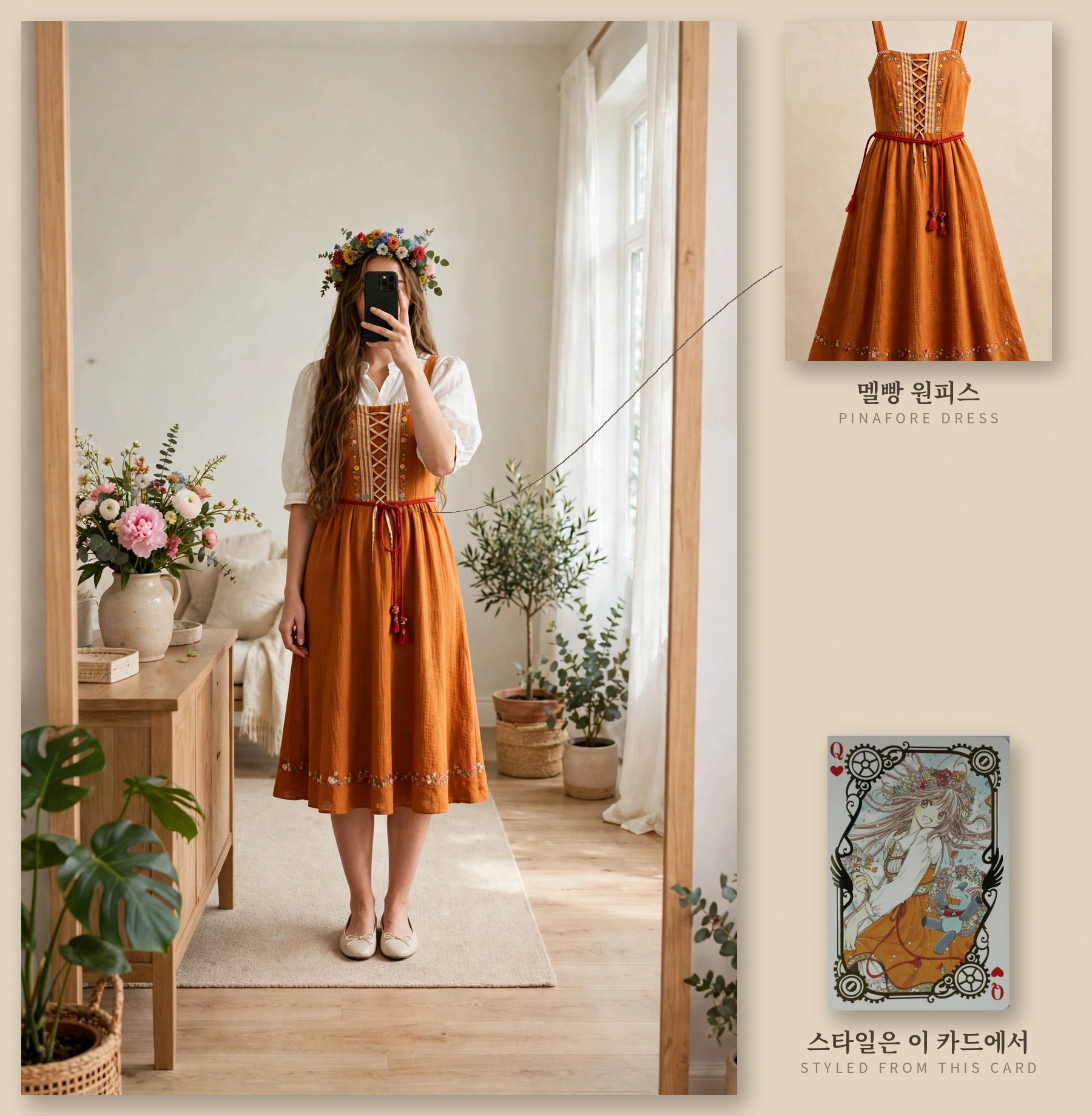
- Lace the front panel to “present”, not to “tight”. Over-lacing is the one move that turns this into a costume.
- Tie the cord once, loosely, and let the tassels hang. It is a drawn line, not a fastening.
- Ballet flats keep the hem’s embroidery company. Sneakers are for days when the flowers should be the only romance.
- The crown is an occasion piece. Without it nothing about the outfit needs to change.
- Swap the blouse to restyle: a plain tee under the straps makes the dress casual; the puff blouse keeps the card’s version.
- Mind the embroidered hem when sitting — it is the skirt’s one delicate part.
Facts and How to Check
- Character: Kobato Hanato (花戸 小鳩), from Kobato. (こばと。) by CLAMP — a bright, kind, accident-prone girl healing wounded hearts to earn her wish; the blue plush-like companion beside her is Ioryogi.
- Card: Queen of Hearts, from the foil playing-card set sold at the CLAMP Exhibition (CLAMP’s 35th anniversary exhibition). All 54 cards carry different illustrations.
- Card items: flower crown, white puff-sleeve blouse, amber-orange pinafore dress (laced front panel, floral-embroidered hem), red cord belt.
- The card shows no footwear; the ballet flats and sneakers are proposals.
- The flat-lay, product and outfit-board images are AI-generated. The card photo is the real item.
The full deck: This look comes from a single card — the whole CLAMP exhibition deck is here → full deck review


Leave a Reply